If you have chronic kidney disease (CKD) or you’re on dialysis, your lab results can feel like a foreign language. You might hear “your potassium is high,” “your uACR is elevated,” or “your Kt/V is low,” and suddenly you’re left wondering what any of it actually means for your body—and for your future.
This guide is designed for kidney disease and dialysis warriors who want clarity, confidence, and control.
We’ll cover:
- The key labs you’ll see most often in CKD and dialysis
- What each lab measures and what it means when it’s high or low
- How some values are calculated (like eGFR and Kt/V)
- Typical reference ranges and targets (with important context)
- How to stop chasing one number and start tracking trends
- How to put all of this into a practical plan
At the end, I’ll share how to take this knowledge and turn it into a step-by-step system with a 30-day plan inside my CKD Survival Starter Pack.
Important note: “Normal” ranges and “targets” vary based on your CKD stage, dialysis type, age, other conditions, and your clinic’s lab standards. Use this article for education and always follow your nephrology team’s guidance.
All research and references cited at end of article in References section
Why kidney labs matter (and why trends beat single numbers)
Kidney labs aren’t just “numbers.” They are signals about:
- Filtering (how well your kidneys remove waste)
- Damage (whether your kidney filters are leaking protein)
- Electrolyte safety (especially heart rhythm and fluid balance)
- Bone and blood vessel health
- Anemia and energy
- Dialysis adequacy (if you’re on treatment)
One of the biggest mindset shifts: a single lab value is a snapshot. Your doctor is watching the trend line. Your goal is to learn how to watch it too—so you can ask better questions and take better action.
Lab #1: eGFR (Estimated Glomerular Filtration Rate)
What it measures
eGFR is an estimate of kidney filtration rate: how much blood your kidneys filter per minute.
It’s one of the most common “headline” numbers in CKD.
What it means
- Higher eGFR generally means better kidney function
- Lower eGFR suggests reduced filtering
But the most important piece is the trajectory:
- Is your eGFR stable for months/years?
- Or is it steadily declining?
How it’s calculated (the “estimate” part)
eGFR is typically calculated using a formula based on:
- Serum creatinine (blood creatinine)
- Age
- Sex
- Sometimes race was used historically; many labs have moved away from race-based equations.
- In some cases, cystatin C may also be used (alone or with creatinine).
It’s not a perfect measurement—it’s a highly educated estimate.
Typical ranges (context matters)
Many labs list eGFR ≥ 60 as “normal,” but eGFR naturally declines with age. CKD staging often uses eGFR bands:
- Stage 1: eGFR ≥ 90 (with evidence of kidney damage, like protein in urine)
- Stage 2: 60–89 (with evidence of damage)
- Stage 3a: 45–59
- Stage 3b: 30–44
- Stage 4: 15–29
- Stage 5: < 15 (kidney failure; dialysis/transplant planning often occurs here)
Why eGFR can fluctuate
Your eGFR can change temporarily with:
- Dehydration
- Illness/infection
- Heavy exercise
- Changes in muscle breakdown
- Some medications
- Recent high-protein intake (can affect creatinine)
Takeaway: Track eGFR over time and ask about your slope.
Lab #2: Creatinine (Serum Creatinine)
What it measures
Creatinine is a waste product from muscle metabolism. Healthy kidneys filter it out through urine.
What it means
- Higher creatinine often means lower filtration
- Lower creatinine may be normal, but very low creatinine can sometimes reflect low muscle mass
How it connects to eGFR
Creatinine is one of the main inputs used to calculate eGFR—so creatinine and eGFR are closely linked.
Typical reference ranges (varies by lab)
Creatinine ranges vary based on sex, age, and muscle mass. Many labs use approximate ranges like:
- ~0.6–1.3 mg/dL (broad reference range)
But for CKD education, the trend is more meaningful than comparing yourself to a generic “normal.”
Why creatinine can be misleading sometimes
Creatinine is influenced by:
- Muscle mass
- Dehydration
- Meat intake
- Some supplements
- Certain medications
That’s one reason we also use urine testing like uACR.
Lab #3: uACR (Urine Albumin-to-Creatinine Ratio)
What it measures
uACR checks how much albumin (a protein) is leaking into your urine, adjusted for urine concentration using creatinine.
In simple terms: uACR tells you about kidney filter damage—not just function.
Why it matters
Protein in urine is a strong risk marker for:
- CKD progression
- Cardiovascular disease risk
You can have a “normal-looking” eGFR and still have an abnormal uACR—especially early in kidney disease.
How it’s calculated
It’s a ratio of:
- Urine albumin divided by urine creatinine
Typical categories (commonly used)
uACR is often categorized as:
- A1: < 30 mg/g (normal to mildly increased)
- A2: 30–300 mg/g (moderately increased)
- A3: > 300 mg/g (severely increased)
Practical tip
Ask your provider if your uACR was done recently—especially if you have diabetes, high blood pressure, or a history of kidney issues. It’s one of the most important early markers.
The “Big Three” electrolytes in CKD and dialysis: Potassium, Phosphorus, Sodium
These three are especially important because they directly influence:
- Heart rhythm and safety
- Bone/vessel health
- Fluid retention and blood pressure
- Dialysis symptoms between treatments
Lab #4: Potassium (K)
What it measures
Potassium is an electrolyte involved in:
- Heart rhythm
- Muscle function
- Nerve signaling
Why it matters in CKD/dialysis
As kidney function declines, potassium can accumulate. High potassium can cause dangerous heart rhythm problems.
Typical reference range
Often around:
- 3.5–5.0 mEq/L (some labs go up to 5.1)
Dialysis clinics may use their own targets.
What high potassium can feel like (sometimes)
- Muscle weakness
- Tingling
- Palpitations
But many people have no symptoms until it’s serious—so labs matter.
Lab #5: Phosphorus (Phosphate)
What it measures
Phosphorus is a mineral involved in:
- Bone structure
- Energy production
- Cell function
Why it matters in CKD/dialysis
When kidneys can’t clear phosphorus efficiently, levels rise and can lead to:
- Itching
- Bone weakness
- Calcium shifting into blood vessels
Dialysis doesn’t always remove phosphorus as efficiently as people think, so management often includes food choices and, for many, binders.
Typical reference range
Often around:
- 2.5–4.5 mg/dL
Dialysis targets are commonly higher than general-population ranges (often aiming ~3.5–5.5 mg/dL, but clinic targets vary).
Lab #6: Sodium (Na)
What it measures
Sodium is a key electrolyte for:
- Fluid balance
- Blood pressure regulation
- Nerve and muscle function
Why it matters
Sodium drives thirst and fluid retention:
- More sodium → more thirst → more fluid gains → higher blood pressure and swelling
- In dialysis, higher fluid gains often mean tougher treatments and cramps
Typical reference range
Often around:
- 135–145 mEq/L
Important nuance: blood sodium may still look “normal” even when dietary sodium intake is high—because your body holds water to keep sodium concentration stable. The real effect shows up as fluid overload and blood pressure, not always a “high sodium lab.”
Lab #7: PTH (Parathyroid Hormone)
PTH is where many CKD patients feel confused, because it connects kidneys, bones, and blood vessels.
What it measures
PTH is a hormone released by the parathyroid glands in your neck. Its mission: keep blood calcium in a safe range.
Why it matters in CKD/dialysis
When kidney function drops:
- Phosphorus tends to rise
- Active vitamin D tends to drop
- Calcium signaling can be disrupted
Your body responds by increasing PTH, which can pull calcium from bones to stabilize blood levels—helpful short-term, harmful long-term.
What “goes into” the PTH number
Two layers:
1) What drives your body to increase PTH
- Calcium (low calcium tends to raise PTH)
- Phosphorus (high phosphorus tends to raise PTH)
- Vitamin D status (low vitamin D can raise PTH)
- CKD stage and dialysis status
- Sometimes magnesium and inflammation
2) How it’s measured
PTH is measured via a blood test, often reported as intact PTH (iPTH). Different labs may use different assays, so your nephrologist usually focuses on trends and clinic-specific targets.
“Normal” ranges and targets
PTH targets vary widely, especially in dialysis. In advanced CKD and dialysis, the goal is typically not “normal population PTH,” but a safer range to reduce bone and vascular risk while avoiding overly suppressing bone turnover.
Ask your clinic:
- “What is my target PTH range for my stage/dialysis type?”
- “Are we trending up or stable?”
Lab #8: Hemoglobin (Hgb) — the anemia/energy lab
What it measures
Hemoglobin is the oxygen-carrying protein in red blood cells.
Why it matters
Low hemoglobin = less oxygen delivery = fatigue, shortness of breath, brain fog, weakness.
Typical targets (CKD/dialysis context)
Hemoglobin targets in CKD/dialysis are not the same as the general population. Many nephrology protocols aim for a range around:
- ~10–11 g/dL (varies by patient, risks, and clinic)
Raising hemoglobin too high with ESA therapy can carry risks—so targets are individualized.
Lab #9: Iron studies (TSAT + Ferritin)
What they measure
Iron studies explain whether your body has:
- iron available right now (TSAT)
- iron stored in reserve (ferritin)
TSAT (Transferrin Saturation)
TSAT reflects the percent of transferrin carrying iron—basically how much iron is ready to use for red blood cell production.
Typical targets vary, but many CKD/dialysis protocols aim for TSAT around:
- ~20–30%+ (clinic dependent)
Ferritin
Ferritin reflects stored iron, but it also rises with inflammation—common in CKD/dialysis—so interpretation is nuanced.
Targets vary widely by clinic and dialysis protocol.
Why these labs matter for energy
You can have a hemoglobin problem because:
- you don’t have enough iron
- you have iron but can’t mobilize it well (inflammation)
- you lack EPO support due to kidney disease
This is why anemia management is usually a system, not a single pill.
3 Dialysis Labs That Are Important
Dialysis adequacy labs: Kt/V and URR
If you’re on hemodialysis or peritoneal dialysis, adequacy is your “dose check.”
Nutrition Quality & Inflammation lab: Albumin
Important during dialysis to understand the quality of your nutrition especially regarding quality protein intake.
Lab #10: URR (Urea Reduction Ratio)
What it measures
URR measures how much urea is removed in one hemodialysis session. It’s calculated by comparing pre- and post-dialysis urea levels.
Typical targets
Many clinics aim for URR:
- ≥ 65% (common target; clinic-specific)
Lab #11: Kt/V
What it measures
Kt/V estimates dialysis adequacy by considering:
- K = dialyzer clearance of urea
- t = time on dialysis
- V = volume of distribution (related to body water/body size)
Why it matters
If adequacy is consistently low, you may feel:
- nauseated
- “toxic”
- itchy
- wiped out
…and long-term it can affect outcomes.
Typical targets (hemodialysis)
Many in-center hemodialysis targets are around:
- Kt/V ≥ 1.2 per treatment (common minimum target; clinic-specific)
Peritoneal dialysis uses different adequacy framing (weekly Kt/V and inclusion of residual kidney function).
Lab #12: Albumin (Serum Albumin)
What it measures
Albumin is a protein made by your liver that circulates in your blood. It plays several critical roles:
- Maintaining fluid balance (keeps fluid in blood vessels instead of leaking into tissues)
- Transporting hormones, vitamins, and medications
- Serving as a marker of overall nutrition and inflammation status
Why it matters in CKD/dialysis
Albumin is often called the “Gold Standard” lab for dialysis outcomes. Low albumin is associated with:
- Poor nutrition
- Inflammation
- Increased hospitalization risk
- Higher mortality risk
In CKD and dialysis, albumin reflects not just what you eat, but how well your body is handling stress, inflammation, and protein metabolism.
How it’s measured
Albumin is measured via a blood test. It’s part of most routine chemistry panels.
Typical reference range
General population reference ranges are often:
- ~3.5–5.0 g/dL
In dialysis, many clinics aim for:
- ≥ 4.0 g/dL (common target; clinic-specific)
Some patients may have lower targets based on individual factors, but higher albumin is generally associated with better outcomes.
What can cause low albumin?
- Poor protein intake (not eating enough high-quality protein)
- Inflammation (chronic inflammation can lower albumin even if protein intake is adequate)
- Protein loss (in nephrotic syndrome or peritoneal dialysis, protein can be lost through urine or dialysate)
- Liver disease
- Fluid overload (can dilute albumin concentration)
Why albumin is especially important on dialysis
Studies consistently show that higher albumin levels are linked to better survival and fewer complications in dialysis patients. It’s one of the most powerful predictors of how well someone will do long-term.
That’s why your care team watches this number closely and may recommend:
- Increasing high-quality protein intake (eggs, lean meats, fish, poultry)
- Managing inflammation
- Optimizing dialysis adequacy
- Addressing fluid status
The “low phosphorus, high protein” challenge
One of the trickiest parts of CKD/dialysis nutrition is getting enough protein to keep albumin up without spiking phosphorus. This is where food choices matter:
High-protein, lower-phosphorus options:
- Egg whites
- Chicken breast
- Fish (especially white fish)
- Lean cuts of meat
High-protein, high-phosphorus foods to limit:
- Dairy products
- Nuts and seeds
- Beans and lentils
- Processed meats with phosphate additives
Practical tip
If your albumin is trending down, ask your dietitian:
- “Am I eating enough protein for my body size and dialysis schedule?”
- “Are there inflammation markers we should check?”
- “Is my dialysis adequacy affecting my nutrition?”
Albumin isn’t just a number—it’s a window into your body’s resilience.
Lab #13: BUN (Blood Urea Nitrogen)
What it is:
BUN stands for Blood Urea Nitrogen. Urea is a waste product your body makes when it breaks down protein from food and normal tissue turnover. Your liver produces urea, and your kidneys are responsible for filtering it out into urine (or removing it with dialysis).
What it measures:
BUN measures the amount of nitrogen from urea circulating in your blood. It’s a helpful clue about:
- How well your kidneys are clearing waste
- Your hydration status
- Protein intake and metabolism
- (In dialysis) how much urea is being removed with treatment
Typical “normal” range (general population):
- ~7–20 mg/dL (ranges vary by lab)
What HIGH BUN can mean:
A high BUN often means there is more urea waste in the blood, but it does not always mean your kidney function suddenly worsened. Common reasons include:
- Reduced kidney function / CKD progression (less filtering)
- Dehydration (less fluid in the bloodstream concentrates BUN)
- High-protein intake (more urea production)
- GI bleeding (protein breakdown from blood in the GI tract can raise BUN)
- Catabolic stress (infection, steroids, major illness) increasing protein breakdown
How it can feel (sometimes):
High BUN can be associated with “uremia” symptoms, especially when it’s very elevated or rising with other waste markers:
- Nausea, low appetite
- Metallic taste or “ammonia” taste
- Brain fog, fatigue
- Itching (often multifactorial)
- Poor sleep/restlessness
(Important: symptoms don’t map perfectly to a single number—look at the whole picture.)
What LOW BUN can mean:
Low BUN is usually less concerning, but can be seen with:
- Low protein intake or malnutrition
- Overhydration (dilution)
- Liver disease (less urea production)
CKD vs. dialysis context (important):
- In CKD (not on dialysis): BUN generally rises as kidney filtration declines, but hydration and diet can swing it significantly.
- In hemodialysis: BUN is used in adequacy calculations (because urea is the “marker waste” we measure). Your care team may check:
- Pre-dialysis BUN (before treatment)
- Post-dialysis BUN (after treatment)
These help calculate URR and contribute to Kt/V.
- In peritoneal dialysis: BUN is also used to assess clearance over time, along with other adequacy measures.
Trend tip (how to track it like a pro):
Don’t panic over one high BUN. Ask:
- “Was I dehydrated or sick before this lab?”
- “Did my protein intake change?”
- “Is creatinine/eGFR changing too—or is this mostly hydration/diet?”
- (Dialysis) “How does my pre/post BUN compare and what does it mean for my URR/Kt/V?”
Bottom line:
BUN is a waste-marker that’s strongly affected by kidney function + hydration + protein intake. It’s most powerful when you interpret it alongside creatinine/eGFR (CKD) or URR/Kt/V (dialysis).
Putting it together: how to track kidney labs like a pro
Knowing what the labs mean is powerful—but the real win is turning them into a repeatable system.
Here’s a simple approach:
1) Track trends, not single results
For each lab, ask:
- Is this stable, improving, or worsening over 3–6 months?
- Did anything change around this time (diet, illness, meds, missed dialysis time, hydration)?
2) Group your labs by “theme”
- Function: creatinine, eGFR
- Damage: uACR
- Safety: potassium, sodium/fluid status
- Bone/mineral: phosphorus, calcium, PTH, vitamin D
- Energy: hemoglobin, iron studies
- Dialysis dose: Kt/V, URR
- Nutrition: albumin
3) Prepare 3 questions for every appointment
Try these:
- “What are my top 2 priorities based on this lab panel?”
- “Is my trend stable or changing?”
- “What’s the one action I should take before the next labs?”
4) Use a simple tracker
The best tracker is the one you’ll actually use—monthly or quarterly—so you can see the story your body is telling.
***Read below for further understanding & a lab tracker I personally created and use***
Your next step: the CKD Survival Starter Pack (with a 30-day action plan)
If this article helped you understand your labs, you’re already ahead—because knowledge is how you advocate for yourself.
But most people still ask:
- “Okay… what do I do next?”
- “How do I track this without getting overwhelmed?”
- “How do I turn labs into daily habits?”
That’s exactly why I created my CKD Survival Starter Pack.
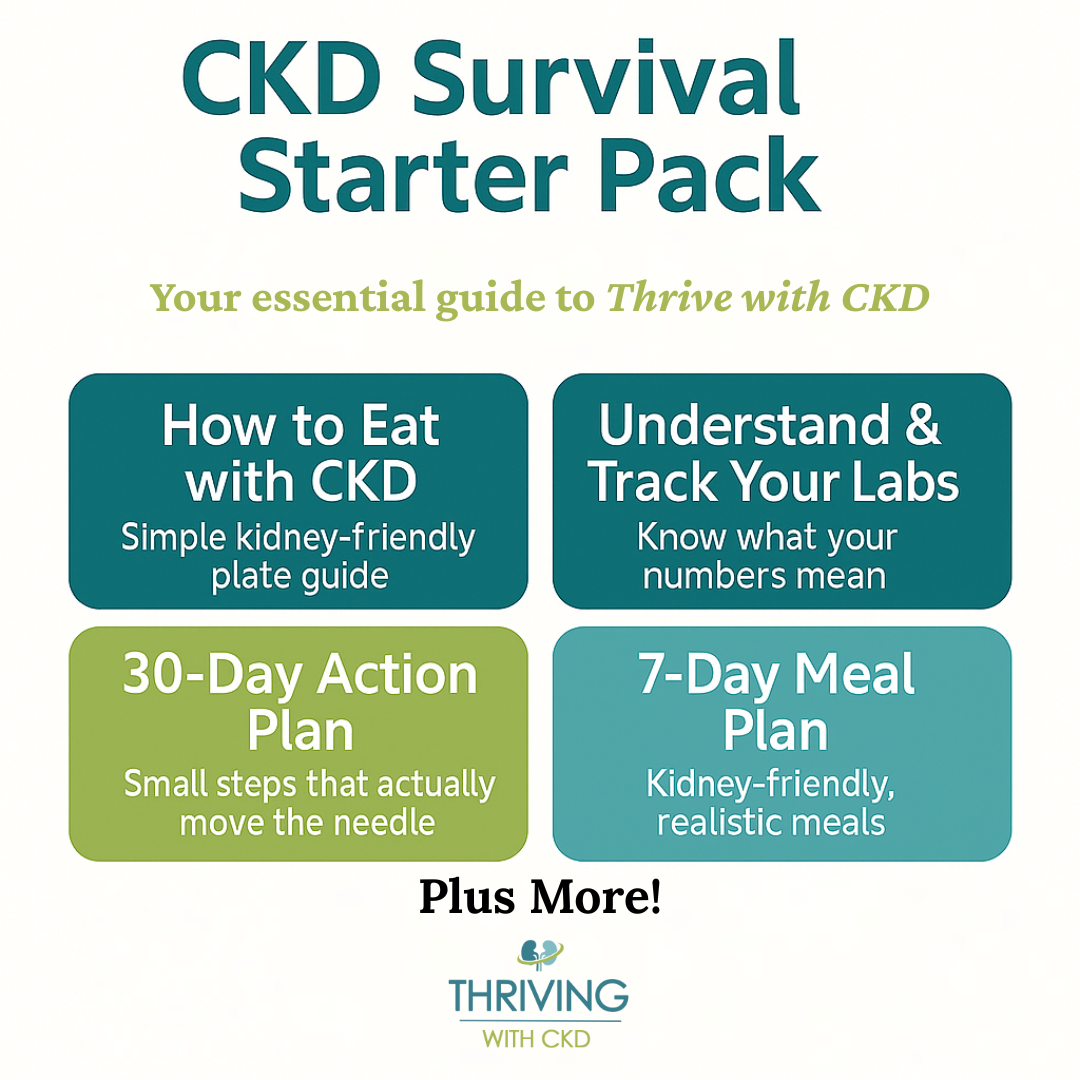
Inside, you’ll get deeper guidance on:
- Key Health, Diet. Labs & Lifestyle Info for CKD
- 30 Day Action Plan
- 7 Day Sample Meal Plan
- 7 Day Sample Workout Plan
- Fluid/Meds/Lab Tracking Kit
- Mindset & Mental Health Tips
- Daily Journal Prompt
Check out the CKD Survival Starter Pack here:
THE CKD SURVIVAL STARTER PACK
You don’t have to guess your way through kidney disease. You can learn your numbers, track your trends, and take action—one step at a time.
If you’d like, comment or message me the lab you struggle with most, and I’ll make a follow-up post for it on ThrivingWithCKD.com as well as a video on my social media @ThrivingWithCKD
FAQ Section
Is eGFR the same as creatinine?
No. Creatinine is a blood waste product; eGFR is a calculated estimate that uses creatinine plus age/sex (and sometimes cystatin C).
Can you have kidney disease with normal eGFR?
Yes. If your uACR is elevated (protein in urine), that can indicate early kidney damage even if eGFR is still above 60.
Why is potassium so dangerous in CKD?
Potassium affects heart rhythm. High potassium can lead to serious arrhythmias with few warning symptoms.
Why does phosphorus matter so much on dialysis?
Phosphorus is hard to remove fully with dialysis and can contribute to bone disease and vascular calcification over time.
What does a low Kt/V mean?
It can mean your dialysis dose isn’t adequate—often due to shortened treatments, access issues, flow rates, dialyzer choice, or needing more time.
References & Clinical Guidelines
- National Kidney Foundation (NKF). Estimated Glomerular Filtration Rate (eGFR). kidney.org
- Kidney Disease: Improving Global Outcomes (KDIGO). 2024 Clinical Practice Guideline for the Evaluation and Management of Chronic Kidney Disease. kdigo.org
- National Institute of Diabetes and Digestive and Kidney Diseases (NIDDK). Urine Albumin-Creatinine Ratio (uACR). niddk.nih.gov
- American Journal of Kidney Diseases (AJKD). KDOQI Clinical Practice Guideline for Nutrition in CKD: 2020 Update. ajkd.org
- Centers for Medicare & Medicaid Services (CMS). Dialysis Adequacy (Kt/V) Methodology and Reporting. cms.gov
- Journal of the American Society of Nephrology (JASN). Management of Anemia in Chronic Kidney Disease. jasn.asnjournals.org
- Kidney Care Quality Alliance (KCQA). *Bone and Mineral Metabolism: PTH and Phosphorus Management in Dialysis. kidneycarequality.org


